
Category Archives: Integrated Marketing

18 Best Practices for Adopting Digital Marketing

Many executives between the ages of 45-65 years are “digital aliens”. They were not brought up in the digital age and feel overwhelmed and sometimes fearful of the new technologies.  Many struggle with the changes necessitated by engaging in Digital Marketing. The result is the New Digital Divide between companies that are fully immersed in digital applications while others are deciding if Facebook is good investment!

18 best digital marketing practicesBelow is a road map of 18 practices* which will facilitate the adoption and successful implementation of a Digital Marketing Program.

1. Assess Current Market Practices- Determine the gaps and opportunities to position your organization in the digital world.
2. Adopt a Digital Mindset – Gain executive understanding and buy-in to the changes required to adopt a digital marketing program. Many executives are not aware of the scope and type of shift needed for successful implementation.
3. Dedicate Resources – Commit staff, provide training; allocate budget.
4. Be Transparent- - Be upfront about your intentions and purposes for your site and interactions.  Many executives fear losing control of their marketing message.  Openness and authenticity generates trust and opportunities.
5. Strategize… Strategize- Design a Digital Marketing Strategy that incorporates your assessment; clarifies goals and brand, integrates all media; tracks and evaluates. More than 60% of social media programs fail without a strategy.
6. Build on what you Do Best – Incorporate digital media to leverage and augment successful marketing efforts.
7. Listen, Research, Refine – Monitor social buzz, real-time customer feedback (forums, tweets, surveys, online reviews); refine your product .
8. Give Value– Focus on giving value before expecting anything in return, including downloadable resources, free advice, and links.
9. Be Consistent, not Overpowering – Maintain your Brand; increase your digital presence through regular conversations, but don’t push, overexpose or irritate.
10. Develop Sustainable Relationships – Engage in conversations, take the time to interact; this is a social environment. Conversations build relationships and encourage participation. Touch your current and potential customers with regular updates and newsletters.
11. Provide Social Sharing- Include easy to access to social amplification tools (e.g., social sharing buttons for Facebook, Twitter, Digg, StumbleUpon, email) to spread the message.
12. Cultivate Satisfied, Loyal Customers- Focus on caring for, thanking, satisfying, and providing value for your customers.  This will engender trust and encourage your “customers do your marketing” via sharing your product with their networks.
13. Leverage Social Communities- Access related social communities that have a potential interest/benefit from your product. These groups can boost exposure and penetration with little additional expense.
14. Develop Online Environment as your Hub- Drive traffic to an integrated online environment including website, Facebook site, landing pages, and blog.
15. Integrate Media –Augment your traditional advertising (TV, radio, outdoor, direct mail, print) and PR with social media, mobile, and online efforts. Integrated Media Marketing forces companies to break down the old silos of individual marketing efforts to synergize elements between the media and generate the social buzz and viral distribution.
16. Monitor your Digital Presence- Track your company’s Digital FootPrint, company chatter and social mentions.
17. Evaluate your Social Return on Investment (SROI)- Evaluate SROI as an tool for measuring a much broader concept of value. It incorporates social, environmental and economic costs and benefits into decision making; it helps to readjust your strategy and tactics to meet your goals.
18. Keep Current…Generate Competitive Edge- Maintain your “fingers on the pulse” of your changing business ecosystem and the digital environment. Timely responses will drive innovation and competitive positioning.

Any other best practices to suggest?

* Expanded on Best and Worst Practices Social Media Marketing

The New Digital Divide

Meeting the Digital Challenge: Part 1

There is little argument that social and digital media are profoundly changing how we, as global society,  engage with the media, our colleagues, family and friends, as well as how we do business.  Most executives and managers are aware of the digital revolution; many of them have explored it through mobile and social media; some have implemented it with varied successes; but few have integrated digital media as strategic priority in their marketing mix. This gap between the growth of digital media and the implementation of a Digital Marketing Strategy is exacerbated when comparing the U.S. with other countries.  The hotbeds for competitiveness and innovation related to the digital economy are Sweden and Singapore. The U.S trails at #5. To maintain a competitive edge, U.S executives and managers must embrace these changes and drive transformation in their organizations. This is the Digital Challenge!

The Revolution

In 2006 Rupert Murdoch, known as the global print giant, suggested we are entering a major revolution.

“To find something comparable, you have to go back 500 years to the printing press, the birth of mass media … Technology is shifting power away from the editors, the publishers, the establishment, the media elite. Now it’s the people who are taking control.”

These statistics demonstrate the Power of the Revolution:

  • More uploads to YouTube in 60 days than all 3 major US networks created in 60 years
  • 110 million tweets are sent per day on Twitter or 4+million  per hour (Twitter)
  • Facebook generates 770 Billion page views, 700+ Billion minutes, every month
  • StumbleUpon (43%) has overtaken Facebook (38%) as #1 source for US social media traffic
  • In 2010, Asia Pacific had more than 825 million internet users, 42% of the global total.

In 2011 Google suggested that digital media has transformed our buying decisions. Marketing has a Changing Rulebook based on Zero Moment of Truth or ZMOT, “the moment when you grab your laptop, mobile phone or some other wired device and start learning about a product or service.”

These statistics tell the story of how our buying behaviors have changed:

Murdoch transformed his investments, building a global Integrated Media Empire including the purchases of MySpace, Hulu, Chinese Media company and Wall Street Journal online. As he suggested, “The world is changing very fast. Big will not beat small anymore. It will be the fast beating the slow.” In 2011, his company’s phone scandal violated the foundations of social media (e.g., transparency, accountability) and is being challenged in the social media.

Google has responded to these changes, “Marketing strategies are simply not keeping pace… modern marketing strategies have to evolve with the changing shape of shopping.“ They are now providing core digital training in ZMOT for all members of their sales team internationally.

How many U.S. Executives are prepared to respond to these challenges?

“Digitally Handicapped”

Even as marketing agencies reinvent themselves to respond to the digital revolution, the reality is that most managers are struggling to learn new skills and evaluate the impact of social media conversations.  More than two-thirds (2/3) of managers admit that they are “digitally handicapped” in relating to understanding and measuring social media conversations and impacts on their brand.

  • “80% [of] marketers admit they are concerned their brand is at risk from not being as engaged with customers, or failing to have a good grasp of how online conversations are impacting their brand.“
  • “Less than 33% have a strong understanding of social media conversations related to their brand.“
  • “70% have very little understanding or use a few tools to measure social media conversations.”

Furthermore, many executives are “afraid of it“.  Here are 28 reasons why CEO’s fear social media.

New Digital Divide

Although the U.S. has led growth in digital technologies, marketers have been slow to respond and incorporate in the marketing mix. Forbes Insights reported that only 11% of US and UK executives surveyed at large businesses listed social media strategy as a leading priority in 2011.   eMarketer reports that 78% of U.S. executives think that a social business strategy is important to future business success, but only 27% deem it a top priority. According to 2010 Economist Intelligence Group’s annual “e-readiness” rankings, “In the race to stay competitive in the emerging digital economy, Nordic nations continue to rule the roost. The U.S. has gained ground, and Asian countries are on the rise.”

In fact, inconsistent responses by U.S. marketers have brought forth a New Digital Divide

“…between companies that truly understand the potential to go deep with their digital marketing efforts, and those that are still contemplating what to do with their Facebook presence… some of the world’s most sophisticated work is being done in [Asia] this region, [while] other companies are still not going beyond the basics.

On one hand, there is growing demand for Digital Marketing services in U.S. but there is a gap in understanding, skill set, and application.  There is a shortage of Business Schools and training programs to fill this need. To fill the void, some of the most innovative work in Digital Marketing is being put forward by groups in Asia, Scandinavia and Europe.

Conclusion

To fill the void and remain competitive, U.S. executives must go beyond the confines of traditional marketing and embrace digital training as a strategic priority or risk falling behind. They must extend digital literacy and lead an organizational commitment to integrate digital marketing into their corporate plan.

Meeting the Digital Challenge is required for survival and growth! Are You Prepared?

Part Two:  Digital Marketing Training … coming soon

GERVAS: 6 Benchmarks for Digital Marketing Strategy

GERVAS:  Goal – Engage – Relationship –  Value –  Action – Synthesize

GERVAS is the tool to guide the development of your social media campaign. Here are the six elements and the questions to ask?

As a business or organization launches a social media program, they try to anticipate the results and make the necessary refinements.   These are some typical questions:

  • Is the content of your social media message effective?
  • Is your target market communicating via social media and will you reach them?
  • Are you choosing and optimizing your social media tools?
  • How do you evaluate your strategy before launch?

Each marketer/ businessperson can apply six simple benchmarks to evaluate the potential effectiveness of your social media efforts. This can be done as a self-evaluation, discussion with your team or via a focus group. Read More »

23 Ways to Integrate Facebook and Twitter with Traditional Advertising

Integrated Media Marketing is when you effectively integrate social media with traditional marketing. Here are 23 ideas for integrating Facebook and Twitter in PR, direct selling, customer services, advertising and sales promotions.

Back of Business Card

  1. Add Facebook Widget /plugins to website or blog
  2. Show Twitter stream on website
  3. Use buttons in footer, contact page and sidebar of  website
  4. Add Share/Like/Tweet buttons on products and content on website
  5. Include links on your business cards
  6. Include info in email signature file
  7. Add Facebook /Twitter to voice mail messages (office and cellphone)
  8. Include Facebook/Twitter info on invoices and receipts Read More »

Six Keys to Optimizing Digital Marketing for Small Businesses

Anyone with a bit of tech savvy can set up Facebook and Twitter accounts and begin posting updates. . But can they accomplish the needs of a business in this digital age?  Can a tech savvy youth create competitive advantage, the key for businesses in meeting their goals?

For most small businesses the answer is NO!   They will contribute to the plethora of un-optimized, under-utilized social media accounts. The result —Digital Hubmany small businesses “try out social media” and contend “it doesn’t work!”

There is an alternative approach- Digital Marketing Optimization (DMO). DMO leverages the power of each media platform and integrates them to drive traffic to your online environment, while achieving your business goals.

DMO designs an online environment that easily connects to other social communities, expanding the reach and exposure of your site. It increases “socially referred traffic” as unique users can easily share comments through audio, video and text links.

Here are six keys to make Digital Media work for small businesses:

  1. Design a Step-by-Step Digital Strategy Read More »

Businesses Adopt Comprehensive Approach to Digital Marketing

Digital Marketing synergizes social media with other media channels to realize ROI. Many companies launch into social and mobile media without creating a strategy.

The old school marketers are transaction oriented. Their strategy is to buy more media eyeballs, potentially creating “buzz” and sales. The new media marketers are customer focused, generating interactivity and relationships.

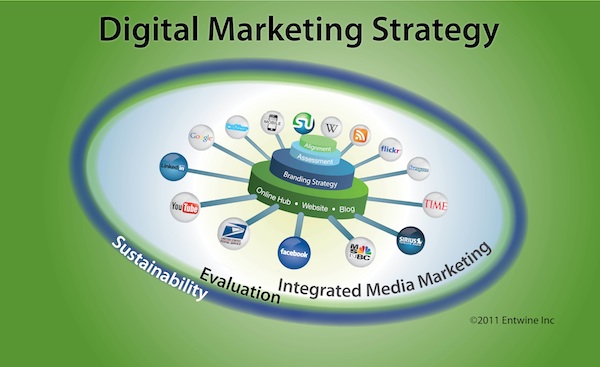
The five phase Digital Marketing Strategy  is comprehensive, customer-centered, and focused on delivering ROI.

Five Phases

  1. Assessment
  2. Strategic Branding
  3. Online Hub
  4. Integrated Media Marketing
  5. Monitoring/Evaluating Read More »

5 Stages of an Integrated Digital Marketing Timeline

Clients generally have unrealistic expectations of a integrated digital marketing strategy.  They expect results immediately or within the first 3-6 months. We prepare our clients for real expectations by reviewing a Digital Marketing Timeline.

Campaign Life Cycle

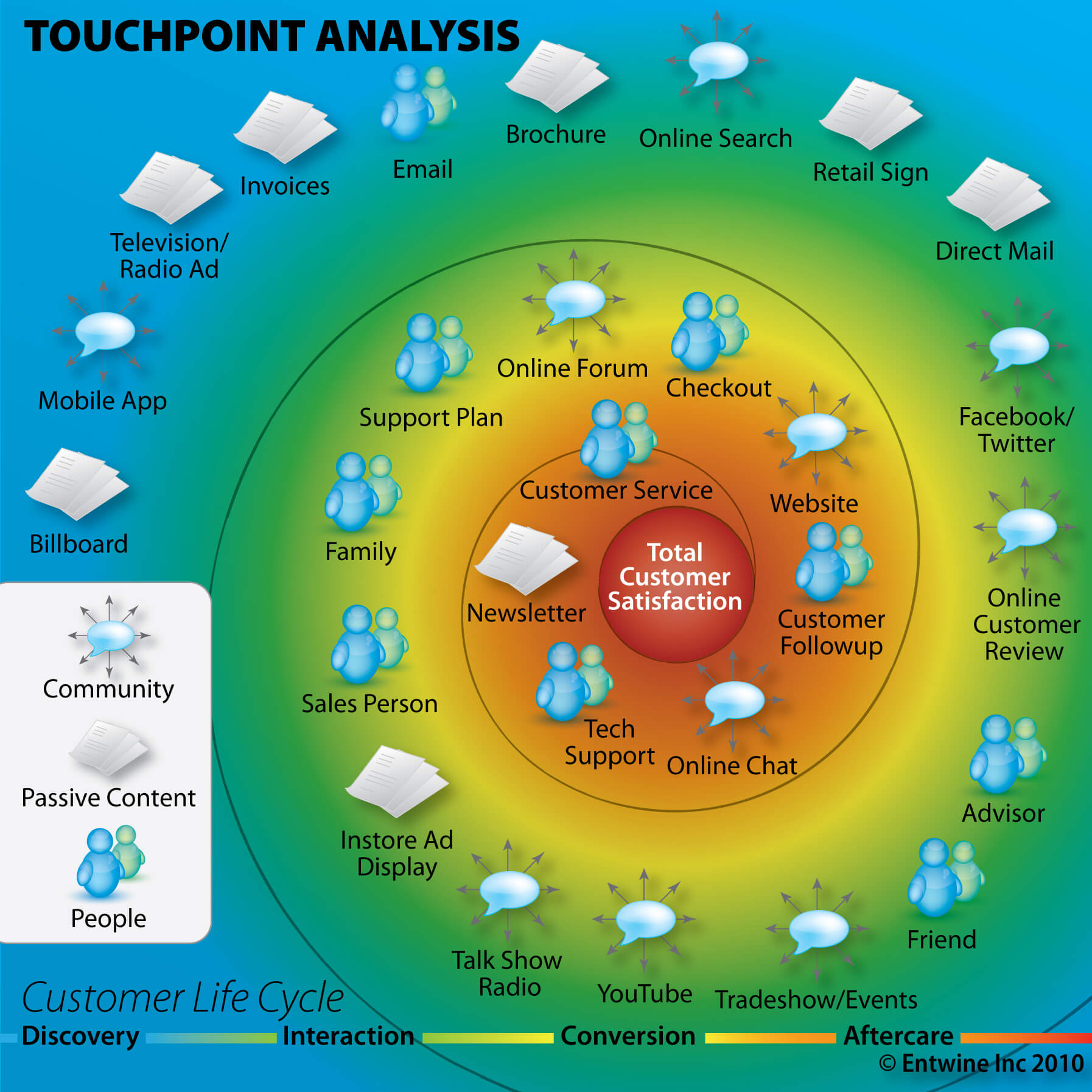
An Integrated Digital Marketing strategy has five stages during a 27+ month period. (note: the timeline can be collapsed to 6+ months depending on the relevancy and the timeliness of the promotion) During each stage the number of touchpoints,  client marketing efforts that  touch the customer, are expanded. These touchpoints build on each other and grow exponentially.  As your network expands the media (traditional advertising, PR, online, social) begin to synergize with each other. In the future a successful strategy will be self generating and grow virally.  The goal is to convert your network of touchpoints to actions that support your strategic objectives. Here are the expectations projected for the five stages of the Digital Marketing Timeline Strategy.

Read More »

Your Six Step Social Media Roadmap

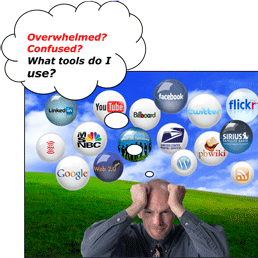
To be successful at social media you need to have a plan.  As the publisher, you control the power to social media confusiondistribute your content through digital media platforms such as blogs, mobile, Facebook, YouTube and Twitter.  Most businesspersons are overwhelmed with all the options and how to implement them.  These six steps provide a roadmap to use social media to achieve optimal results for your business.

Step 1 –Determine Social Media Value for Your Business

  • Develop an understanding of social media and online communities – How can you gain traction for ideas and grow your network to benefit your company?
  • Determine goals – What does your company want to accomplish with social media?
  • Evaluate social media – Is it a good fit for your company/institution?

Step 2 – Identify Challenges Facing Your Business When Implementing Digital Marketing

  • Determine organization’s changes – how will your company adopt social media? Read More »

5 Steps to Evaluating Social Media ROI

touchpoints‘Prove to me social media works!’

That is the cry of many businesspeople when challenged by the hype of Twitter and Facebook. The answer will not come simply from growing social media followers.  Rather, it will come from the effect social media has on expanding and converting your company’s touchpoints. The marketing strategy of every company is to touch their customers, engage them, and move them to a targeted action.  But most companies are not aware of their touchpoints, their effectiveness and why they work.  “Touchpoint Optimization Strategy ” is a 5-step process that tracks the conversion from a one way touchpoint to an “action point” in the customer relationship lifecycle.

Step 1: Listening

Many companies view their touchpoints as one-way, passive listening posts to the voice of the consumer or feedback on the effectiveness of traditional marketing efforts.  Sales and consumer insights measures include surveys, ad test, awareness tracking, contact centers, media tests, customer satisfaction studies, and brand tracking.  However, these listening posts often provided measures that are “time challenged”, needing to wait for the end of a marketing effort before being able to “listen” to the results and gain feedback. Read More »